Saturday, January 06, 2007

Shenpa

Below is an excerpt from a teaching by regarding the Tibetan principle of shenpa. If you like it, I encourage you to check out her audiobook called Getting Unstuck. Pema is a wonderful teacher with a down to earth style and a terrific sense of humor.

<> <> <>

Shenpa is the urge, the hook, that triggers our habitual tendency to close down. We get hooked in that moment of tightening when we reach for relief. To get unhooked we begin by recognizing that moment of unease and learn to relax in that moment.

You're trying to make a point with a coworker or your partner. At one moment her face is open and she's listening, and at the next, her eyes cloud over or her jaw tenses. What is it that you're seeing?

Someone criticizes you. They criticize your work or your appearance or your child. At moments like that, what is it you feel? It has a familiar taste in your mouth, it has a familiar smell. Once you begin to notice it, you feel like this experience has been happening forever.

The Tibetan word for this is shenpa. It is usually translated "attachment," but a more descriptive translation might be "hooked." When shenpa hooks us, we're likely to get stuck. We could call shenpa "that sticky feeling." It's an everyday experience. Even a spot on your new sweater can take you there. At the subtlest level, we feel a tightening, a tensing, a sense of closing down. Then we feel a sense of withdrawing, not wanting to be where we are. That's the hooked quality. That tight feeling has the power to hook us into self-denigration, blame, anger, jealousy and other emotions which lead to words and actions that end up poisoning us. Remember the fairy tale in which toads hop out of the princess's mouth whenever she starts to say mean words? That's how being hooked can feel. Yet we don't stop—we can't stop—because we're in the habit of associating whatever we're doing with relief from our own discomfort. This is the shenpa syndrome. The word "attachment" doesn't quite translate what's happening. It's a quality of experience that's not easy to describe but which everyone knows well. Shenpa is usually involuntary and it gets right to the root of why we suffer...

"
Shenpa thrives on the underlying insecurity of living in a world that is always changing. We experience this insecurity as a background of slight unease or restlessness. We all want some kind of relief from that unease, so we turn to what we enjoy—food, alcohol, drugs, sex, work or shopping. In moderation what we enjoy might be very delightful. We can appreciate its taste and its presence in our life. But when we empower it with the idea that it will bring us comfort, that it will remove our unease, we get hooked. So we could also call shenpa "the urge"—the urge to smoke that cigarette, to overeat, to have another drink, to indulge our addiction whatever it is. Sometimes shenpa is so strong that we're willing to die getting this short-term symptomatic relief. The momentum behind the urge is so strong that we never pull out of the habitual pattern of turning to poison for comfort. It doesn't necessarily have to involve a substance; it can be saying mean things, or approaching everything with a critical mind. That's a major hook. Something triggers an old pattern we'd rather not feel, and we tighten up and hook into criticizing or complaining. It gives us a puffed-up satisfaction and a feeling of control that provides short-term relief from uneasiness...

"Those of us with strong addictions know that working with habitual patterns begins with the willingness to fully acknowledge our urge, and then the willingness not to act on it. This business of not acting out is called refraining. Traditionally it's called renunciation. What we renounce or refrain from isn't food, sex, work or relationships per se. We renounce and refrain from the shenpa. When we talk about refraining from the shenpa, we're not talking about trying to cast it out; we're talking about trying to see the shenpa clearly and experiencing it. If we can see shenpa just as we're starting to close down, when we feel the tightening, there's the possibility of catching the urge to do the habitual thing, and not doing it. Without meditation practice, this is almost impossible to do...


"The Tibetan word for renunciation is shenlok, which means turning shenpa upside-down, shaking it up. When we feel the tightening, somehow we have to know how to open up the space without getting hooked into our habitual pattern. In practicing with shenpa, first we try to recognize it. The best place to do this is on the meditation cushion.

Sitting practice teaches us how to open and relax to whatever arises, without picking and choosing. It teaches us to experience the uneasiness and the urge fully, and to interrupt the momentum that usually follows. We do this by not following after the thoughts and learning to come back to the present moment. We learn to stay with the uneasiness, the tightening, the itch of shenpa. We train in sitting still with our desire to scratch. This is how we learn to stop the chain reaction of habitual patterns that otherwise will rule our lives. This is how we weaken the patterns that keep us hooked into discomfort that we mistake as comfort. We label the spinoff "thinking" and return to the present moment.


Once we're aware of shenpa, we begin to notice it in other people. We see them shutting down. We see that they've been hooked and that nothing is going to get through to them now. At that moment we have prajna. That basic intelligence comes through when we're not caught up in escaping from our own unease. With prajna we can see what's happening with others; we can see when they've been hooked. Then we can give the situation some space. One way to do that is by opening up the space on the spot, through meditation. Be quiet and place your mind on your breath. Hold your mind in place with great openness and curiosity toward the other person. Asking a question is another way of creating space around that sticky feeling. So is postponing your discussion to another time...

"We could think of this whole process in terms of four R - s: recognizing the shenpa, refraining from scratching, relaxing into the underlying urge to scratch and then resolving to continue to interrupt our habitual patterns like this for the rest of our lives. What do you do when you don't do the habitual thing? You're left with your urge. That's how you become more in touch with the craving and the wanting to move away. You learn to relax with it. Then you resolve to keep practicing this way. Working with shenpa softens us up. Once we see how we get hooked and how we get swept along by the momentum, there's no way to be arrogant.

The trick is to keep seeing. Don't let the softening and humility turn into self-denigration. That's just another hook. Because we've been strengthening the whole habituated situation for a long, long time, we can't expect to undo it overnight. It's not a one-shot deal. It takes loving-kindness to recognize; it takes practice to refrain; it takes willingness to relax; it takes determination to keep training this way. It helps to remember that we may experience two billion kinds of itches and seven quadrillion types of scratching, but there is really only one root shenpa—ego-clinging. We experience it as tightening and self-absorption. It has degrees of intensity. The branch shenpas are all our different styles of scratching that itch.

I recently saw a cartoon of three fish swimming around a hook. One fish is saying to the other, "The secret is non-attachment." That's a shenpa cartoon: the secret is—don't bite that hook. If we can catch ourselves at that place where the urge to bite is strong, we can at least get a bigger perspective on what's happening. As we practice this way, we gain confidence in our own wisdom. It begins to guide us toward the fundamental aspect of our being—spaciousness, warmth and spontaneity.

Tuesday, January 02, 2007

Ford eulogy


Although I was just a small child during his presidency and while I did not always agree with his political views, Gerald Ford seems to me to have been a great human being. I believe he did our country a great service in leading it with decency and integrity during a difficult chapter in our history. He was a man of humility and humor, and he will be be missed.

The journalist Tom Brokaw gave a moving eulogy today at Ford's funeral, and I reprint it here because I think it captures President Ford's basic decency and wit. If only more of our leaders were like him...

> > < <


Mrs. Ford, members of the Ford family, President and Mrs. Bush, Vice President and Mrs. Cheney, President and Mrs. Bush, President and Mrs. Carter, President and Mrs. Clinton, distinguished guests, my fellow Americans, it’s a great privilege and an honor for me to be here.

For the past week, we have been hearing the familiar lyrics of the hymns to the passing of a famous man, the hosannas to his decency, his honesty, his modesty and his steady-as-she-goes qualities. It’s what we’ve come to expect on these occasions.

But this time there was extra value, for in the case of Gerald Ford, these lyrics have the added virtue of being true.

Sometimes there are two versions to these hymns — one public and one private, separate and discordant. But in Gerald Ford, the man he was in public, he was also that man in private.

Gerald Ford brought to the political arena no demons, no hidden agenda, no hit list or acts of vengeance. He knew who he was and he didn’t require consultants or gurus to change him. Moreover, the country knew who he was and despite occasional differences, large and small, it never lost its affection for this man from Michigan, the football player, the lawyer and the veteran, the Congressman and suburban husband, the champion of Main Street values who brought all of those qualities to the White House.

Once there, he stayed true to form, never believing that he was suddenly wiser and infallible because he drank his morning coffee from a cup with a presidential seal.

He didn’t seek the office. And yet, as he told his friend, the late, great journalist Hugh Sidey, he was not frightened of the task before him.

We could identify with him — all of us — for so many reasons. Among them, we were all trapped in what passed for style in the 70’s with a wardrobe with lapels out to here, white belts, plaid jackets and trousers so patterned that they would give you a migraine. The rest of us have been able to destroy most of the evidence of our fashion meltdown, but presidents are not so lucky. Those David Kennerly photographs are reminders of his endearing qualities, but some of those jackets — I think that they’re eligible for a presidential pardon or at least a digital touchup.

As a journalist, I was especially grateful for his appreciation of our role, even when we challenged his policies and taxed his patience with our constant presence and persistence. We could be adversaries but we were never his enemy, and that was a welcome change in status from his predecessor’s time.

To be a member of the Gerald Ford White House press corps brought other benefits as well as we documented a nation and a world in transition, in turmoil. We accompanied him to audiences with the notorious and the merely powerful. We saw Tito, Franco, Sadat, Marcos, Suharto, the shah of Iran, the emperor of Japan, China with Mao Zedong, Zhou Enlai and Deng Xiaoping all at once, what was then the Soviet Union and Vladivostock with Leonid Brezhnev, and Helsinki at one of the most remarkable gatherings of leaders in the 20th century.

There were other advantages to being a member of his press corps that we didn’t advertise quite as widely. We went to Vail at Christmas and Palm Springs at Easter time with our families. Now cynics might argue that contributed to our affection for him. That is not a premise that I wish to challenge.

One of our colleagues, Jim Naughton of The New York Times, personified the spirit that existed in the relationship. He bought from a San Diego radio station promoter a large mock chicken head that had attracted the president’s attention at a G.O.P. rally. And then, giddy from 20-hour days and an endless repetition of the same campaign speech, Naughton decided to wear that chicken head to a Ford news conference in Oregon with the enthusiastic encouragement of the president and his chief of staff, Dick Cheney.

In the next news cycle, the chicken head was a bigger story than the president. And no one was more pleased than the man that we honor here today in this august ceremony.

When the president called me last year and asked me if I would participate in these services, I think he wanted to be sure that the White House press corps was represented. The writers, correspondents and producers, the cameramen, photographers, the technicians and the chicken.

He also brought something else to the White House, of course. He brought the humanity that comes with a family that seemed to be living right next door. He was every parent when he said my children have spoken for themselves since they were old enough to speak — and not always with my approval. I expect that to continue in the future.

And was there a more supportive husband in America than when his beloved Betty began to speak out on issues that were not politically correct at the time. Together, they put on the front pages and in the leads of the evening newscasts the issues that had been underplayed in America for far too long.

My colleague Bob Schieffer called him the nicest man he ever met in politics. To that I would only add the most underestimated.

In many ways I believe football was a metaphor for his life in politics and after. He played in the middle of the line. He was a center, a position that seldom receives much praise. But he had his hands on the ball for every play and no play could start without him. And when the game was over and others received the credit, he didn’t whine or whimper.

But then he came from a generation accustomed to difficult missions, shaped by the sacrifices and the depravations of the Great Depression, a generation that gave up its innocence and youth to then win a great war and save the world. And when that generation came home from war, they were mature beyond their years and eager to make the world they had saved a better place. They re-enlisted as citizens and set out to serve their country in new ways, with political differences but always with the common goal of doing what’s best for the nation and all the people.

When he entered the Oval Office, by fate not by design, Citizen Ford knew that he was not perfect, just as he knew he was not perfect when he left. But what president ever was?

But he was prepared because he had served his country every day of his adult life and he left the Oval Office a much better place. The personal rewards of his citizenship and his presidency were far richer than he had anticipated in every sense of the phrase.

But the greatest rewards of Jerry Ford’s time were reserved for his fellow Americans and the nation he loved.

Farewell, Mr. President. Thank you, Citizen Ford.

Thursday, December 28, 2006


When you've seen beyond yourself
then you may find
peace of mind is waiting there
And the time will come
when you see we're all one
and life flows on within you and without you

The Beatles

Saturday, December 16, 2006

Hijāb and niqāb


Today, my husband and I were at Barnes & Noble and saw a woman wearing an abaya (loose, long-sleeve, full-length robe), ħijāb (headscarf) and niqāb (facial covering). It was, I think, the first time I had seen a woman in public in the U.S. wearing the full complement of traditional Muslim ħijāb.

I confess my first response was negative. First, I felt badly for the woman. She had a young child--perhaps a year old--in a stroller and the child was screaming, and she could not get the baby to stop crying. Would the baby have been more easily soothed if it could see its mother's face?

I wondered if she wore the ħijāb and niqāb by choice, or if she was compelled by her male relatives or community to dress in this way. I feel strongly that people should have the freedom of choice, and felt that if she truly chose this manner of dress freely, then I should have no reason to pity her. For a number of years I worked with a young woman (an Eastern European immigrant who converted to Islam) who wore loose-fitting long sleeves and skirts with her ħijāb, and I respected her choice to wear such garments as a reminder of the Islamic rules of modesty. However, to think that a woman might be forced (by custom or otherwise) to wear the ħijāb and niqāb bothers me.

I was also reminded of a Florida court case a couple of years ago in which a Muslim woman sued the State of Florida because they would not allow her to wear her niqāb in her driver's license photo. (She lost the case when a Florida appellate court ruled that the state could legitimately require her to show her face to a camera in a private room with only a female employee to take the picture, in exchange for the privilege of driving.)

As my mind filled with negative thoughts of the niqāb-clad woman, I reminded myself of the Bodhisattva Vow, and that my wish for her should be the same as my wish for all other beings: that she be happy and free of suffering, niqāb or no niqāb. I hoped that somehow she could sooth her upset child, and in whatever circumstances she lived, that she would be content, shielded from hatred and protected from harm, and warmed by feelings of lovingkindness.

With metta,

D.S.

Sunday, December 10, 2006

Saturday, December 09, 2006

Interconnectedness


We human beings are not separate from the universe.
Those galaxies are not merely distant--they are distant cousins.

Gerald Grow

I found some software that can be used to create mandalas. I have made several so far (all in a very convenient 1024 x 768 size, perfect for wallpaper) and will post my favorite ones on this blog.

Friday, December 08, 2006

Mandala


"Iris"

(I made this mandala. I hope you like it. Namaste.)

Friday, November 24, 2006

Letting go

Two monks were at the edge of a river they wished to cross when a woman approached them. She said that she probably wouldn't be able to cross on her own and would appreciate some help. The younger of the monks remained silent and let the more established practitioner speak - he said that yes, he could carry her across.

He did so without much fanfare and bid her farewell on the other side of the river. Then the younger monk exploded. The older monk had been defiled by touching her! He'd renounced sex and yet had his hands all over that woman! That went directly against his vows! The older monk calmly replied: "I put her down a long time ago. Why are you still carrying her?"

Wednesday, November 22, 2006

Introspection is the key to the door of wisdom


We lead a contemplative life, but that does not mean we sit in meditation all day long. A contemplative life means that one considers every aspect of what happens as part of a learning experience. One remains introspective under all circumstances. When one becomes outgoing, with what the Buddha termed "exuberance of youth," one goes to the world with one's thoughts, speech and action. One needs to recollect oneself and return within. A contemplative life in some orders is a life of prayer. In our way it's a combination of meditation and life-style. The contemplative life goes on inside of oneself. One can do the same thing with or without recollection. Contemplation is the most important aspect of introspection. It isn't necessary to sit still all day and watch one's breath. Every move, every thought, every word can give rise to understanding oneself.

Ayya Khema


I love Ayya Khema. She is, along with Pema Chodron, Thich Nhat Hanh and Lama Surya Das, among my favorite Buddhist teachers. She passed away in 1997, but she wrote twenty-five books during her eighteen years as a nun in the Theravadin tradition. I recommend her 1998 book Being Nobody, Going Nowhere. A survivor of the Nazi Holocaust, she speaks with a gentleness and compassion that could only come from one who understands the journey from suffering to acceptance.

Sunday, November 19, 2006

Cultivating joy


"How do we cultivate the conditions for joy to expand? We train in staying present. In sitting meditation, we train in mindfulness and maitri [lovingkindness]: in being steadfast with our bodies, our emotions, our thoughts. We stay with our own little plot of earth and trust that it can be cultivated, that cultivation will bring it to its full potential. Even though it's full of rocks and the soil is dry, we begin to plow this plot with patience. We let the process evolve naturally.

At the beginning it is just a feeling that joy is workable. We stop looking for a more suitable place to be. We've discovered that the continual search for something better does not work out. This doesn't mean that there are suddenly flowers growing where before there were only rocks. It means that we have confidence that something will grow here."

Pema Chödrön

Saturday, November 18, 2006

The Bodhisattva Vow


The Bodhisattva Vow is the commitment to put others before oneself.

It is a statement of willingness to give up one’s own well-being, even one’s own enlightenment, for the sake of others. And a bodhisattva is simply a person who lives in the spirit of that vow, perfecting the qualities known as the six paramitas—generosity, discipline, patience, exertion, meditation, and transcendental knowledge—in his effort to liberate beings.

Taking the bodhisattva vow implies that instead of holding our own individual territory and defending it tooth and nail, we become open to the world that we are living in.

Chögyam Trungpa

(From The Collected Works of Chögyam Trungpa, Volume Three, edited by Carolyn Rose Gimian. © 2003 by Diana J. Mukpo. Published by Shambhala Publications.)

Friday, November 17, 2006

Tolerance

"Move beyond any attachment to names."

Every war and every conflict between human beings has happened because of some disagreement about names.

It's such an unnecessary foolishness, because just beyond the arguing there's a long table of companionship, set and waiting for us to sit down.

What is praised is one, so the praise is one too, many jugs being poured into a huge basin.

All religions, all this singing, one song.

The differences are just illusion and vanity. Sunlight looks slightly different on this wall than it does on that wall and a lot different on this other one, but it is still one light. We have borrowed these clothes, these time-and-space personalities, from a light, and when we praise, we pour them back in.

Mawlānā Jalāl ad-Dīn Muhammad Rūmī (1207—1273)

Sunday, November 12, 2006

The Four Immeasurables


May all living beings have happiness and the causes of happiness;
May all living beings be free from misery and the causes of misery;
May all living beings never be separated from happiness, devoid of misery;
May all living beings abide in equanimity free from prejudicial attachments and aversions.

- Buddha Shakyamuni

Saturday, November 04, 2006

The sacred lotus


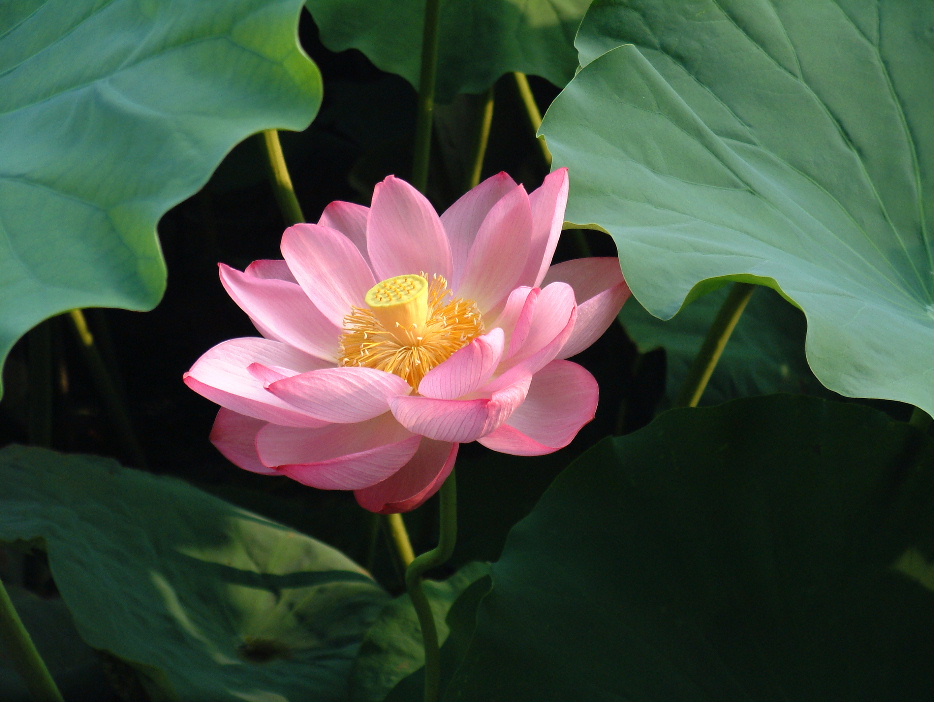
The lotus appears frequently in Buddhist teachings. Why is the lotus such a powerful symbol?

The sacred lotus, nelumbo nucifera, grows in marshy areas. Its roots cling to the bottom of the pond or stream in which it grows, while its petals floats on the surface of the water and its flower sits atop the stem a couple of centimeters above the water.

The lotus flower, therefore, symbolizes purity of mind. By practicing the Eightfold Path, the practitioner can elevate her mind above the muddy quagmire of suffering. We should all seek to be like the lotus, remaining aware of the pain of existence and yet rising above temptation, hatred and greed to express the natural beauty of compassionate consciousness.

May each of you bloom like the lotus...

Namaste.